
Spirit of Paint (SOP) a French website has the skinny on the new bunker kit being foisted on the PSP & Millennium Series this year--and not so incidentally on the local fields that support competitive paintball and on us too! (Link is the title.) In the recent post, Supporting Adrenaline Games, VFTD takes the PSP to task largely for past sins as it turns out the Sup'Air people have intentionally put the league in the position this season of having to accept the new kit in order to have enough fields available for the 5 events this coming year.
Perhaps worse is the change being made. Check out the SOP article for pictures of the new props. For those who don't read French below is the Google Translation:
Here's a preview of the obstacles that will be used this year on the land side snake in Europe and the United States on the PSP system!
You find that the spectator side became boring? You will be served. With these new obstacles to former Lower adorning the grounds of major tournaments, and the new L-shaped design, players will have to be more technical on this side.
The Upgrade Kit will consist of at Supairball 4 "Chips" (Beams in the Angliche) and 4 "L" (for Elbows). They will replace the six fries usually found on the lands of last season.
It'll just test them to tell us what happens.
Attack!
Previous field kits had 6 Giant Beams in Sup'Air speak. The new "upgrade" apparently reduces that number to 4 Chips--which appear to be the same except slightly narrower--and 4 L's. As they are displayed in the article's photographs they are damn near worthless as playable props. There is nothing "technical" about them. They will remove much of the skill of playing a snake effectively while shrinking the size of the snake at the same time. All the new bunkers demonstrate is Adrenaline Games lack of imagination and desperation in trying to force us into buying and using these pointless changes. (It may be possible to find alternate uses for the Ls but that's clearly not what Sup'Air intends.)
And does anybody know what the full field kit will be comprised of this season? Are any other bunkers out besides (apparently) the 6 GBs of the past?
I don't know that anything can be done now but at a minimum Adrenaline needs to pay a price down the road. I bet the kids at Ultimate can make a Giant Beam package available pretty quick to replace the "upgrade." Then nobody would need the upgrade because the league wouldn't be using those new props. I know but I can dream, right?
Saturday, February 4, 2012


Friday, February 3, 2012
Chips Ahoy!
VFTD has discussed the Virtue chips in the past (for example here & here) and while I had intended to leave it at that until something new developed--and there are plenty of ideas in the pipeline--it seems that with the recent NPPL announcement of their intention to use the chips across all their non-pump divisions of play to enforce the ROF cap it has created--if not a firestorm of misinformation--a tiny tempest of confusion.
Instead of attempting to refute assorted misinformation I'm simply going to give you the facts as they stand today. Anything else you may hear will be either wrong, disinformation, conjecture or, at best, outcomes intended to be implemented some time in the future.
The chip can monitor a ROF cap. In this instance the cap is 15 bps. The chip can identify guns exceeding the cap, it does NOT enforce the cap. That remains a matter for the rules and rules enforcement. The chip does NOT identify bouncing, ramping or any other artificial shot adding. It does provide data that with experience and testing may suggest shots are being added but that falls into the category of data interpretation. The interpreter is a person, not the technology.
The chip can monitor ROF because it is recording each discharge from every monitored gun in real time. This has resulted, over the period of time the chip has been in trials--primarily by pro teams in both major leagues--in a substantial amount of raw data. The same kind of data that will accumulate across divisions in the NPPL during events assuming everything goes to plan. All current "information" within the data is a matter of interpretation and statistical analysis built on the firing of the guns in play.
Okay but what about the claims made by the NPPL? (here) (Which mostly fall in line with what Virtue has been promoting.) For example, what about the player stats? Player Effectiveness tracks how many of the opponents were eliminated while a given player remained active. Does that tell you that the active player was responsible for any of the eliminations? It does not. Even with an accumulation of data covering many games does the stat really confirm the effectiveness of a player? I don't think so. It may but at best it's inconclusive. Or how about the Stamina stat? Let's apply it to a lead snake player. Depending on his role he could easily be one of the first players eliminated routinely. Does that mean he isn't doing his job?
One thing the accumulated stats do allow for is comparisons. Alone a stat's value may be uncertain but since stats will exist for every player it should be possible to compare similar players or positions by stats in which case the data may prove valuable. I think the jury remains out on that too but it's a viable possibility.
The same applies to team and game stats. Yes, numbers and notions can be generated from the raw data but the question remains about the real utility of those numbers and notions. Unfortunately the stats don't generate themselves and part of the ongoing process will be in pulling the stats from the raw data.
I am, btw, pro stats. I think having bite size numbers and easy ways of looking at our game helps make it accessible. And some of the stats the chip offers may prove popular and if that's all the "stats" do they could still serve a valuable function. On the cautionary side claims made for the numbers aren't the numbers and the numbers, in my estimation, do not necessarily validate the claims made. All I'm suggesting is to look past the hype. Take the claims with a grain of salt and examine what the numbers are really all about. At worst it's harmless and at best it is a legit tool in rules enforcement and may provide new ways for people to think about the game.
Apart from functionality it seems to me a couple of other issues arise. In traditional 7-man it's relatively simple to keep track of guns & players. In the Race 2 format with the quick turnarounds and changing lines it may be a singular challenge to try and keep track of the gun (chip) / player association. And while chips can be installed in a minute or two it will almost certainly prove nearly impossible in Race 2 format matches to swap out the chips to different guns which means teams will likely need extras. If each specific chip isn't always associated with a specific player it poisons the data and the stats derived become unreliable so it's going to be a rather big deal trying to keep up with which chip is being used by which player in which game or point.
Instead of attempting to refute assorted misinformation I'm simply going to give you the facts as they stand today. Anything else you may hear will be either wrong, disinformation, conjecture or, at best, outcomes intended to be implemented some time in the future.
The chip can monitor a ROF cap. In this instance the cap is 15 bps. The chip can identify guns exceeding the cap, it does NOT enforce the cap. That remains a matter for the rules and rules enforcement. The chip does NOT identify bouncing, ramping or any other artificial shot adding. It does provide data that with experience and testing may suggest shots are being added but that falls into the category of data interpretation. The interpreter is a person, not the technology.
The chip can monitor ROF because it is recording each discharge from every monitored gun in real time. This has resulted, over the period of time the chip has been in trials--primarily by pro teams in both major leagues--in a substantial amount of raw data. The same kind of data that will accumulate across divisions in the NPPL during events assuming everything goes to plan. All current "information" within the data is a matter of interpretation and statistical analysis built on the firing of the guns in play.
Okay but what about the claims made by the NPPL? (here) (Which mostly fall in line with what Virtue has been promoting.) For example, what about the player stats? Player Effectiveness tracks how many of the opponents were eliminated while a given player remained active. Does that tell you that the active player was responsible for any of the eliminations? It does not. Even with an accumulation of data covering many games does the stat really confirm the effectiveness of a player? I don't think so. It may but at best it's inconclusive. Or how about the Stamina stat? Let's apply it to a lead snake player. Depending on his role he could easily be one of the first players eliminated routinely. Does that mean he isn't doing his job?
One thing the accumulated stats do allow for is comparisons. Alone a stat's value may be uncertain but since stats will exist for every player it should be possible to compare similar players or positions by stats in which case the data may prove valuable. I think the jury remains out on that too but it's a viable possibility.
The same applies to team and game stats. Yes, numbers and notions can be generated from the raw data but the question remains about the real utility of those numbers and notions. Unfortunately the stats don't generate themselves and part of the ongoing process will be in pulling the stats from the raw data.
I am, btw, pro stats. I think having bite size numbers and easy ways of looking at our game helps make it accessible. And some of the stats the chip offers may prove popular and if that's all the "stats" do they could still serve a valuable function. On the cautionary side claims made for the numbers aren't the numbers and the numbers, in my estimation, do not necessarily validate the claims made. All I'm suggesting is to look past the hype. Take the claims with a grain of salt and examine what the numbers are really all about. At worst it's harmless and at best it is a legit tool in rules enforcement and may provide new ways for people to think about the game.
Apart from functionality it seems to me a couple of other issues arise. In traditional 7-man it's relatively simple to keep track of guns & players. In the Race 2 format with the quick turnarounds and changing lines it may be a singular challenge to try and keep track of the gun (chip) / player association. And while chips can be installed in a minute or two it will almost certainly prove nearly impossible in Race 2 format matches to swap out the chips to different guns which means teams will likely need extras. If each specific chip isn't always associated with a specific player it poisons the data and the stats derived become unreliable so it's going to be a rather big deal trying to keep up with which chip is being used by which player in which game or point.
Thursday, February 2, 2012
Supporting Adrenaline Games
It's that time of year again--apparently--when the PSP supports Adrenaline Games by sticking it to the local field operators that support the PSP and Race 2. Was that too harsh? Upon re-reading it sounds pretty harsh. Unfortunately it's also true.
Confused? Here's the dealio. Every year or so it seems Sup'Air adds some new props that the major tournament leagues incorporate in their event layouts (also frequently designed by Sup'Air) that forces fields with airball fields used for tourney practice to buy the annual new props kit in order to keep up to date. Good for Adrenaline Games, not so good for local fields.
I noticed the NPPL expressly didn't change their bunker set this season--an unequivocal thumbs up--and it appears that Adrenaline Games hasn't kicked them to the curb by refusing to provide event fields or gone out of business. And while I have no desire to see anything bad happen to Adrenaline Games I have a hard time understanding how any league can justify placing their grassroots supporters in that position to benefit a third party. It's practically extortion.
Beyond that I have a couple of other issues too. Since when do real sports let manufacturers dictate what essential elements of the game will be? Yeah, I know, competitive paintball has always been an old boys club. Now's as good a time as any to change. Also, why is somebody other than those responsible for the sport deciding what's an appropriate change? Seriously, the whole thing ought to be a no go.
That doesn't mean the bunkers shouldn't ever be changed. Want to add some interest? Keep the game fresh? Sure. Sounds good but that's a job for the PSP--or any other league purporting to be focused on competitive paintball as sport.
UPDATE: Mr. Curious weighs in with some on point rumorology. It seems the PSP thought they had a deal with Adrenaline Games to make bunker changes every other year and had no intention of changing in 2012. Seems the first the league heard about the latest changes came from sources outside of Adrenaline Games. When confronted Sup'Air allegedly claimed they only had 4 2011 field sets left and given that the league uses upwards of 20 field sets a season the PSP was left with little alternative but to accept this year's changes. It will be interesting, to say the least, how the league responds to this practical blackmail in the future.
Confused? Here's the dealio. Every year or so it seems Sup'Air adds some new props that the major tournament leagues incorporate in their event layouts (also frequently designed by Sup'Air) that forces fields with airball fields used for tourney practice to buy the annual new props kit in order to keep up to date. Good for Adrenaline Games, not so good for local fields.
I noticed the NPPL expressly didn't change their bunker set this season--an unequivocal thumbs up--and it appears that Adrenaline Games hasn't kicked them to the curb by refusing to provide event fields or gone out of business. And while I have no desire to see anything bad happen to Adrenaline Games I have a hard time understanding how any league can justify placing their grassroots supporters in that position to benefit a third party. It's practically extortion.
Beyond that I have a couple of other issues too. Since when do real sports let manufacturers dictate what essential elements of the game will be? Yeah, I know, competitive paintball has always been an old boys club. Now's as good a time as any to change. Also, why is somebody other than those responsible for the sport deciding what's an appropriate change? Seriously, the whole thing ought to be a no go.
That doesn't mean the bunkers shouldn't ever be changed. Want to add some interest? Keep the game fresh? Sure. Sounds good but that's a job for the PSP--or any other league purporting to be focused on competitive paintball as sport.
UPDATE: Mr. Curious weighs in with some on point rumorology. It seems the PSP thought they had a deal with Adrenaline Games to make bunker changes every other year and had no intention of changing in 2012. Seems the first the league heard about the latest changes came from sources outside of Adrenaline Games. When confronted Sup'Air allegedly claimed they only had 4 2011 field sets left and given that the league uses upwards of 20 field sets a season the PSP was left with little alternative but to accept this year's changes. It will be interesting, to say the least, how the league responds to this practical blackmail in the future.
Wednesday, February 1, 2012
CFPS 1 Breakdown
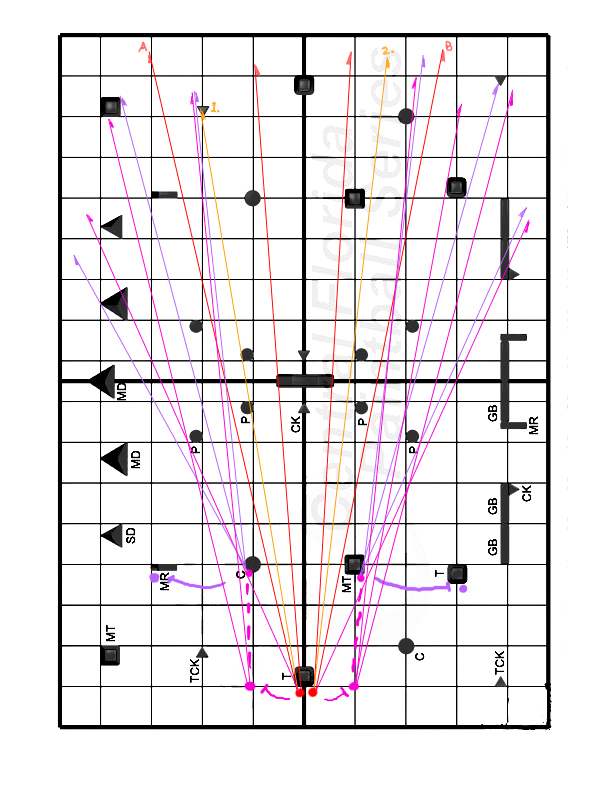
Let's begin with a quick review of the layout. It's nearly an archetypal Xball design except there's little value in attacking up the center and none of the corners offer any significant wire control. Each corner section of the field is made up of a triangle of three props; the insert, the feed and the corner. The value of playing the corners is largely to command edges from an advantageous position in assisting teammates to make the move to the wire and/or denying same to your opponent. Adding some variation are the two mid standing props; the D-Can & the Aztec. To regular competitors even these ought to look familiar as this relative placement is quite common as well. Given the layout the points played will feature (and reward) strong gun play and coordinated action. (Communicate, communicate, communicate.) The mid-field stand-ups will also encourage some teams to play them consistently and defensively oriented teams will want to cross them up as often as not. Our focus will be on the breakout and how to utilise the stand-ups more offensively as part of a diversified attack.
 In diagram A the red lines are principle lanes. Note the lines marked A & B. They are the primary OTB lanes from Home. The interior red lines are optional and only useful if your opponent is delaying their breakouts or attempting to counter your Home shooters. Take a look now at the orange lines marked 1 & 2. 2 is an option to either red snake side lane and may catch the occasional floater intent on shooting a lane before making his/her primary prop. If the opponent is consistently breaking hard that lane is unlikely to be effective as it will almost always be late. 1 is a bit different. Note how the lane crosses over a Pin. One of the secrets to effective laning OTB is to find and utilise unusual lanes that catch players unaware. However, there are risks. In this case the Home shooter must shoot the lane standing--or nearly so--otherwise the paint won't drop in time to hit the TCK (and be at a level that may catch your opponent.) (Shooting lane 1 from a kneeling posture won't be effective because of the angle change unless the shooter's velocity is well below normal ranges.) Likewise, standing or not shooting over the mirror Pin on your opponent's half of the field won't hit anyone except perhaps a player delaying close to the back boundary. The pink lines show the secondary lanes available if the OTB shooter stays Home or makes the delayed move to one of the mid-field stand-ups. Note that the pink dots approximate alternative "Home" OTB laning positions and offer the shooter good laning zones and the ability, in most instances, to put paint on likely props. The purple lines are the same side lanes that are available once the player is in a midfield stand-up. Take note of purple arrows indicating a rotation toward the wire from the stand-ups. The stand-ups offer an excellent alternative path to the wire feeds particularly if there is a teammate in the corner. (The best option is to match that rotation to a support player in a corner but it isn't necessary.)
 Switching to diagram B note the props surrounded in green. The green lines represent the primary Home OTB lanes and the more effectively those lanes are shot the greater the likelihood your opponent will begin holding up on their wide breakout moves. Containment provides new offensive opportunities. (This is likely to occur more often on the D-side of the field as most teams will play weakside on the D-side. This means they will tend to commit only two of their 5 players that way.) Better yet if the opposition uses the Can to play the cross field angles you are no facing only one gun caught in a compact insert. And even if, when using the Can on the cross field, Home stays D-side the opportunity to attack the center of the field as a secondary option remains. The goal is to eliminate the widest gun (and at a minimum hold them in that spot) while positioning yourself to deny any moves to your wire while gaining new angles to threaten other positions. So while it is probably not an effective move to go up the center OTB given the right circumstances--circumstances your team can force on your opponent--secondary moves up the middle ought to be nearly automatic responses to the correct set of conditions.
In both diagrams the focus is on making full use of the stand-ups effective lanes while maintaining an offensive mindset. Too often teams, newer and lower division ones in particular, tend toward a defensive approach regardless of their talk or intentions and this can happen unconsciously even in playing certain props--like these midfield stand-ups--that promote a defensive style.

In both diagrams the focus is on making full use of the stand-ups effective lanes while maintaining an offensive mindset. Too often teams, newer and lower division ones in particular, tend toward a defensive approach regardless of their talk or intentions and this can happen unconsciously even in playing certain props--like these midfield stand-ups--that promote a defensive style.
Tuesday, January 31, 2012
The (NPL) National Paintball League
There is an announcement about the NPL in the News section at PBN. There is also the NPL website here. First order of business is to suggest perhaps a less generic name for the league as it turns out lots of nations have national paintball leagues. Just an observation. Second, I want to separate the NPL vision into two parts; the game format and league structure.
Let's begin with the game format. While I'm not a fan of swapping offense and defense I will limit my concerns to problems not opinions. The principle one being uncapped semi-auto marker operation. A serious league cannot validate a mode of operation that cannot be regulated. And since the only way the defense can score a point requires elimination of the flag carrier in his/her end zone the rules also encourage illegal modes of operation. (And if refs start penalizing teams and players for things they think but can't prove happened it opens the league to unnecessary conflict and controversy.) Also, no where is the league's field set of props outlined by numbers or type. And, as with other forms of competitive paintball this will directly impact the nature of the game as it plays out as will the layout(s) used. (Though one might assume a NPPL style bunker set given the field dimensions although that would prove problematic from a game play perspective.) The other thing of note is the apparent requirement to provide scoreboards, time clocks and scorekeepers able to keep track of all the game records as matches are played. One assumes these are built in costs that a local field operator must commit to before the league even gets off the ground in his "region." If there was a simplified way to run a match it would make it more attractive for fields to opt in and give it a try.
As mentioned in passing in a previous post I think a rigid adherence to the structure as currently outlined is counterproductive. While there needs to be some sense of how all the pieces fit together as the league grows the important part, especially in this formative stage, is that it grow period. And as with any developing venture there will be growing pains and as more people and regions become involved there will be more and more diverse opinions about what ought to come next regardless of what's written down already. If the outline of the future league structure is taken as a set of guidelines instead of set in concrete the league becomes flexible enough to deal with issues as they arise. That said there are numerous incongruities and conflicts in the current details. The following is just a sample, not a comprehensive review. (And if it seems confusing I'm responding to the Rule Book and Players Guide so you're only getting half the "conversation".) For example, "regions" are defined essentially as local fields which is okay but confusing. Not okay is that local field owners are also team owners and regional directors. (Each region is supposed to comprise of 6 teams--unless it's eleven--but don't ask me how that works 'cus it isn't explained anywhere--and the field owner also owns those teams and essentially runs his little corner of the NPL too.) Regional directer--yes. Team owner--no. In part because only the Regional Director can approve trades but since that same person is all the team owners he's "approving" decisions he instigated in the first place. That's not oversight, that's nonsense. Get more local people actively involved who have an interest in the outcomes and success of individual teams. The rankings "system" given is a mess and if a region actually operated the combine completely unnecessary. The combine demonstrates talent and the teams draft eligible players. Some outside source of artificial ranking is completely unnecessary particularly given the NPL's definition for pro and semi-pro players. But seriously while sounding cool the combine and draft are a no go. (Only authorized NPL professionals will be allowed to be involved in testing and evaluations? And just who will be an authorized NPL professional and what is the criteria the league will use to determine that status? Really?) Best of all just jettison the combine (drug testing?) and the draft and the rankings because, according to the NPL, they are all Amateur players. Some teams will be better than others. So what? The Regional Director controls who plays and who doesn't and can provide competitive balance. Meanwhile not so good teams will have a reason to work to get better and recruit new players, etc. There's more but this is enough for now.
Finally there is a sanctioned NPL paintball. Why? If the idea is competitive balance that's fine. If it's part of a funding scheme for the NPL then less so but understandable. (Minimum event day purchases.) But then how is the league funded? It isn't actually outlined anywhere though there are hints in the section on registering players in which pros, semi-pros are apparently expected to pay a pro and registration fee while Ams only pay a registration fee. Otherwise how will the league afford its commitments to the regional teams once the playoffs begin? Did anybody crunch the numbers? Where will the national championships be held? Lots of partially formulated structures, short on some of the details that will matter to the players and teams.
The simple fact is if the league has any chance to succeed it needs to focus on getting local fields participating and making it as simple and easy for local players to get involved. Bottom line, the game may appeal to lots of players but it's going to have a hard time getting off the ground with all the extra unnecessary baggage its lugging around.
Let's begin with the game format. While I'm not a fan of swapping offense and defense I will limit my concerns to problems not opinions. The principle one being uncapped semi-auto marker operation. A serious league cannot validate a mode of operation that cannot be regulated. And since the only way the defense can score a point requires elimination of the flag carrier in his/her end zone the rules also encourage illegal modes of operation. (And if refs start penalizing teams and players for things they think but can't prove happened it opens the league to unnecessary conflict and controversy.) Also, no where is the league's field set of props outlined by numbers or type. And, as with other forms of competitive paintball this will directly impact the nature of the game as it plays out as will the layout(s) used. (Though one might assume a NPPL style bunker set given the field dimensions although that would prove problematic from a game play perspective.) The other thing of note is the apparent requirement to provide scoreboards, time clocks and scorekeepers able to keep track of all the game records as matches are played. One assumes these are built in costs that a local field operator must commit to before the league even gets off the ground in his "region." If there was a simplified way to run a match it would make it more attractive for fields to opt in and give it a try.
As mentioned in passing in a previous post I think a rigid adherence to the structure as currently outlined is counterproductive. While there needs to be some sense of how all the pieces fit together as the league grows the important part, especially in this formative stage, is that it grow period. And as with any developing venture there will be growing pains and as more people and regions become involved there will be more and more diverse opinions about what ought to come next regardless of what's written down already. If the outline of the future league structure is taken as a set of guidelines instead of set in concrete the league becomes flexible enough to deal with issues as they arise. That said there are numerous incongruities and conflicts in the current details. The following is just a sample, not a comprehensive review. (And if it seems confusing I'm responding to the Rule Book and Players Guide so you're only getting half the "conversation".) For example, "regions" are defined essentially as local fields which is okay but confusing. Not okay is that local field owners are also team owners and regional directors. (Each region is supposed to comprise of 6 teams--unless it's eleven--but don't ask me how that works 'cus it isn't explained anywhere--and the field owner also owns those teams and essentially runs his little corner of the NPL too.) Regional directer--yes. Team owner--no. In part because only the Regional Director can approve trades but since that same person is all the team owners he's "approving" decisions he instigated in the first place. That's not oversight, that's nonsense. Get more local people actively involved who have an interest in the outcomes and success of individual teams. The rankings "system" given is a mess and if a region actually operated the combine completely unnecessary. The combine demonstrates talent and the teams draft eligible players. Some outside source of artificial ranking is completely unnecessary particularly given the NPL's definition for pro and semi-pro players. But seriously while sounding cool the combine and draft are a no go. (Only authorized NPL professionals will be allowed to be involved in testing and evaluations? And just who will be an authorized NPL professional and what is the criteria the league will use to determine that status? Really?) Best of all just jettison the combine (drug testing?) and the draft and the rankings because, according to the NPL, they are all Amateur players. Some teams will be better than others. So what? The Regional Director controls who plays and who doesn't and can provide competitive balance. Meanwhile not so good teams will have a reason to work to get better and recruit new players, etc. There's more but this is enough for now.
Finally there is a sanctioned NPL paintball. Why? If the idea is competitive balance that's fine. If it's part of a funding scheme for the NPL then less so but understandable. (Minimum event day purchases.) But then how is the league funded? It isn't actually outlined anywhere though there are hints in the section on registering players in which pros, semi-pros are apparently expected to pay a pro and registration fee while Ams only pay a registration fee. Otherwise how will the league afford its commitments to the regional teams once the playoffs begin? Did anybody crunch the numbers? Where will the national championships be held? Lots of partially formulated structures, short on some of the details that will matter to the players and teams.
The simple fact is if the league has any chance to succeed it needs to focus on getting local fields participating and making it as simple and easy for local players to get involved. Bottom line, the game may appeal to lots of players but it's going to have a hard time getting off the ground with all the extra unnecessary baggage its lugging around.
Monday, January 30, 2012
Monday Poll in Review
No Monday Poll for you! No, you didn't do anything. You are, after all, a lazy slacker. I just didn't have a good poll topic--so no poll this week. If you've got any ideas you know what to do with them. (Take that however you like.)
UPDATE: I lied. There is a Monday Poll. The off topic who will win the SuperBowl Poll.
Last week's The Monday Poll asked about the best way(s) to improve tournament paintball. Since much the dialogue lately has revolved around the virtues of restricted paint and/or reduced ROF it's small wonder they were popular categories. Perhaps most interesting was that the only category that didn't receive any votes was Lower maximum velocity. Not a one. Less energy, less pain on impact, right? Less energy maybe more guns can consistently shoot more fragile paint. Less energy fewer breaks at longer ranges more live players after the breakout. And not one vote. The next 3 categories with the fewest votes look to have split the M. Carter Brown voters with 3% favoring a return to woods tournaments, 3% longing for the larger fields of yesteryear and a whopping 6% ready to dust off their cockers and automags and go mechanical. When semi-auto was really semi-auto and a man was a man and an enormous drop forward let you tuck that 118/3000 in nice and tight. (Right.) I'm not sure I believe it though 'cus the PSP has tried offering Tactical Race 2 [mech guns] and it ain't like they are turning teams away. The fact is even the UWL hasn't garnered much interest in all mech gun teams so those who say they want it either don't really or are so broke they can't play anyway. Four categories tied at 9% each. The pipedream universal industry standard semi-auto board or chip or whatever. Even if all the obstacles involved were overcome nobody would really want it if they had it or, more to the point, were compelled to use it because it would be too slow. I can pull faster than this, it's ruined my gun, this is no fun, etc. Also at 9% were restricted paint and lowered ROF for the lower divisions of competitive play. Of course when the PSP tried to tier ROF by experience the crowd that would have benefited most raised the biggest ruckus. And while limited paint leagues existed in the past I don't know of any currently in the U.S. Whatever plusses either option has it ain't gonna happen if nobody is willing to play that way. (At the same time it's possible to educate--or in raehl's case, browbeat--the tourney crowd into eventually seeing that a recommended alternative might not be such a bad idea after all but it's necessarily a time consuming process.) Last of the 9 percenters was more props. Fill that field up. More choices. Closer together. More angles and lanes blocked. Heck, if you stay low it almost becomes a game of hide & seek--which everybody knows is way better than capture the flag.
Next at 10% was bring back the 10-man game. I hear this a lot. What I haven't heard is anyone trying to bring it back and having any grand success. I keep suggesting to the PSP that Masters play ought to be Race 2-2 and that they'd get more geezers playing--but maybe they wouldn't. Tactical has been about as popular as a pick-up artist in a lesbian bar and for all the 10-man nostalgia I haven't seen any evidence that anybody would show up if they built it. At 11% we have the lowered ROF across all divisions of play which is, if nothing else, a testament to Brockdorff's tenacity, enthusiasm and good cheer. Which brings us to the top 2 vote getters; a completely new format (14%) & restricted paint across all divisions (17%). One thing this poll result suggests is that there is no widely held opinion of what the answer is or ought to be. Even so I'm mildly surprised that nearly 15% opted for the unknown which I think tells us more about some level of present dissatisfaction than it does an expectation of what the unknown format might deliver. I find it curious but as with all these results I think most of the votes are soft votes in the sense that you people (the voters) aren't do or die committed to your choices. Any of them. Although apparently raehl's restricted paint crowd wants to make sure everybody suffers if they have to or else maybe they imagine a time in the near future when restricted paint will allow them to play at the upper levels of competition.
So apparently if we restrict paint, lower the ROF, add props, enlarge the field, use mech guns with 10 players per side using a brand new format tournament paintball as we know (and love) it will be saved. Hurrah!
UPDATE: I lied. There is a Monday Poll. The off topic who will win the SuperBowl Poll.
Last week's The Monday Poll asked about the best way(s) to improve tournament paintball. Since much the dialogue lately has revolved around the virtues of restricted paint and/or reduced ROF it's small wonder they were popular categories. Perhaps most interesting was that the only category that didn't receive any votes was Lower maximum velocity. Not a one. Less energy, less pain on impact, right? Less energy maybe more guns can consistently shoot more fragile paint. Less energy fewer breaks at longer ranges more live players after the breakout. And not one vote. The next 3 categories with the fewest votes look to have split the M. Carter Brown voters with 3% favoring a return to woods tournaments, 3% longing for the larger fields of yesteryear and a whopping 6% ready to dust off their cockers and automags and go mechanical. When semi-auto was really semi-auto and a man was a man and an enormous drop forward let you tuck that 118/3000 in nice and tight. (Right.) I'm not sure I believe it though 'cus the PSP has tried offering Tactical Race 2 [mech guns] and it ain't like they are turning teams away. The fact is even the UWL hasn't garnered much interest in all mech gun teams so those who say they want it either don't really or are so broke they can't play anyway. Four categories tied at 9% each. The pipedream universal industry standard semi-auto board or chip or whatever. Even if all the obstacles involved were overcome nobody would really want it if they had it or, more to the point, were compelled to use it because it would be too slow. I can pull faster than this, it's ruined my gun, this is no fun, etc. Also at 9% were restricted paint and lowered ROF for the lower divisions of competitive play. Of course when the PSP tried to tier ROF by experience the crowd that would have benefited most raised the biggest ruckus. And while limited paint leagues existed in the past I don't know of any currently in the U.S. Whatever plusses either option has it ain't gonna happen if nobody is willing to play that way. (At the same time it's possible to educate--or in raehl's case, browbeat--the tourney crowd into eventually seeing that a recommended alternative might not be such a bad idea after all but it's necessarily a time consuming process.) Last of the 9 percenters was more props. Fill that field up. More choices. Closer together. More angles and lanes blocked. Heck, if you stay low it almost becomes a game of hide & seek--which everybody knows is way better than capture the flag.
Next at 10% was bring back the 10-man game. I hear this a lot. What I haven't heard is anyone trying to bring it back and having any grand success. I keep suggesting to the PSP that Masters play ought to be Race 2-2 and that they'd get more geezers playing--but maybe they wouldn't. Tactical has been about as popular as a pick-up artist in a lesbian bar and for all the 10-man nostalgia I haven't seen any evidence that anybody would show up if they built it. At 11% we have the lowered ROF across all divisions of play which is, if nothing else, a testament to Brockdorff's tenacity, enthusiasm and good cheer. Which brings us to the top 2 vote getters; a completely new format (14%) & restricted paint across all divisions (17%). One thing this poll result suggests is that there is no widely held opinion of what the answer is or ought to be. Even so I'm mildly surprised that nearly 15% opted for the unknown which I think tells us more about some level of present dissatisfaction than it does an expectation of what the unknown format might deliver. I find it curious but as with all these results I think most of the votes are soft votes in the sense that you people (the voters) aren't do or die committed to your choices. Any of them. Although apparently raehl's restricted paint crowd wants to make sure everybody suffers if they have to or else maybe they imagine a time in the near future when restricted paint will allow them to play at the upper levels of competition.
So apparently if we restrict paint, lower the ROF, add props, enlarge the field, use mech guns with 10 players per side using a brand new format tournament paintball as we know (and love) it will be saved. Hurrah!
Sunday, January 29, 2012
The Baca Addendum Explained
You didn't ask for it--but then you didn't need to 'cus you knew it was coming, eventually. We got some field time in yesterday playing with the BA rules and to be honest the jury is still out. I'll explain in a minute but first I'ma outline the rules.
It's very simple. There are two flags. Each team begins with a flag at their start position. Anyone (live player) can possess the flag to begin the point. Only a live player possessing their team flag can score a point. If the flag carrier is eliminated the flag is placed where visible nearest the elimination position and a different live player from that team can regain possession--but only if there is at least one live player opponent on the field. Once the opposing team has been eliminated an unpossessed flag is out of play and no point is scored by either team.
The two flags provide visual info for following the strategy and implementation of each team's effort and the live player possession rule means a team either must protect the flag possessor or be prepared at a moment's notice to regain possession. Theoretically it allows for an offensive or defensive game plan but field layouts will, as they presently do, tend to dictate the preferred strategy.
The jury is still out because we didn't really get to play enough points or complete a match and as the concept was a foreign one to everybody but me the players were still adapting and trying to figure out what they wanted to do. Did they want the flag further upfield or not if the original carrier was eliminated? And as often as not they forgot about the necessity of having the flag to score either until it was too late or they were left scrambling to get across the field to try and reach their flag. The mindset was the game they are used to playing.
It needs more play to determine its real potential and it needs players adjusted to the way live flags potentially alter the tactics and strategy of a match--which is a big change for experienced players used to doing things a particular way. Who knows, it may also need fine tuning as well.
If anyone wishes to give it a go feel free to do so--and let us know how it goes. If you just want to argue about it hypothetically, or throw out suggestions or whatever that's fine too--you know where to find the comments.
It's very simple. There are two flags. Each team begins with a flag at their start position. Anyone (live player) can possess the flag to begin the point. Only a live player possessing their team flag can score a point. If the flag carrier is eliminated the flag is placed where visible nearest the elimination position and a different live player from that team can regain possession--but only if there is at least one live player opponent on the field. Once the opposing team has been eliminated an unpossessed flag is out of play and no point is scored by either team.
The two flags provide visual info for following the strategy and implementation of each team's effort and the live player possession rule means a team either must protect the flag possessor or be prepared at a moment's notice to regain possession. Theoretically it allows for an offensive or defensive game plan but field layouts will, as they presently do, tend to dictate the preferred strategy.
The jury is still out because we didn't really get to play enough points or complete a match and as the concept was a foreign one to everybody but me the players were still adapting and trying to figure out what they wanted to do. Did they want the flag further upfield or not if the original carrier was eliminated? And as often as not they forgot about the necessity of having the flag to score either until it was too late or they were left scrambling to get across the field to try and reach their flag. The mindset was the game they are used to playing.
It needs more play to determine its real potential and it needs players adjusted to the way live flags potentially alter the tactics and strategy of a match--which is a big change for experienced players used to doing things a particular way. Who knows, it may also need fine tuning as well.
If anyone wishes to give it a go feel free to do so--and let us know how it goes. If you just want to argue about it hypothetically, or throw out suggestions or whatever that's fine too--you know where to find the comments.
Friday, January 27, 2012
APPA Classification Score Inflation
This is a critique, not a criticism. Short history lesson: In the early months of this blog I likened the then UCP to Logan's Run and suggested the system (and the league) was unnecessarily driving players up and out of competitive paintball. Which was true. Since that time the classification system has been adjusted a number of times in ways that (intentionally or unintentionally) fell in line with VFTD's original criticisms.
In a recent post about Social Paintball I took them to task a bit for a contributor who simply regurgitated the old claim--first made here--purely to engender some controversy. It has since occurred to me that the system was tweeked again and that I hadn't reviewed in detail the latest changes and if I was going to give Social some grief over it I oughta make sure nothing major had changed. And nothing major has changed--but a situation that hadn't been addressed before has been now, sorta. That is the relative merit of a score received depending on the size of the division.
One of the score modifiers is # of teams in a division. Any number 10 and above doesn't modify the received score. For divisions less than 10 teams there is a modifier that reduces the overall score received based I presume on the idea that it's more difficult to win out in a bracket of 20 teams than it is in a bracket of 8 teams and regardless there is necessarily a higher likelihood of competitive intensity in the larger bracket. Conceptually I'm okay with that but where I think an issue exists is at the other end of the team numbers spectrum.
Given the current scoring system every team, other than first and last, receive a score that accounts for the number of participants--at least in part. For example in a division of 12 second place receives 92 points (rounded) while the same second place finish in a division of 8 receives 87 points. The # teams modifier goes further and will reduce that base score even further--which is okay--but that's not where the score inflation problem lies. Score inflation produces disparate values when the divisions get bigger.
Btw, the reason this is a critique and not a criticism is because, despite the score inflation, a quick crunching of the numbers demonstrates that, unlike in times past, this won't effect the upper divisions where the problems of the past primarily resided but it might have an impact on the lower divisions, principally D3 & D4.
Here's an example: 6th place in a division of 8 is 35 points (rounded); in a division of 10 it's 50 points & in a division of 20 teams it's 75 points. In a division of 30 teams 6th place receives 85 points. Each result is a 6th place finish but also results in a swing of 50 points between the lowest and highest score. Of course in one sense the swing reflects the degree of difficulty in arriving at that placement; 6th out of 30 is considerably more difficult--at least statistically--than 6th out of 8 and while I happily concur that's not the issue either.
The issue with score inflation is that the classification system determines a player's status based on multiples of a base score. If your division nevers exceeds 12 or 15 teams it own't ever be a concern. In divisions that routinely reach or exceed 30 teams it could be a problem. And when I say "problem" I mean produce a result where players are bumped up when they shouldn't be. Fortunately the present system has sufficient safe guards--and most D4 & D3 teams don't play a full season--so that score inflation alone shouldn't push players (& teams) up a division.
A simple way to address the issue would be to reconsider the size of the smallest max score division and adjust the reducing multipliers--or leave it as is accepting score inflation because most of time it probably won't be a problem.
(And of course it ought to go without saying, but I'm saying it anyway, I may differ with APPA on occasion but only because it is a serious and legit effort--unlike the revenue stream mockery used by the other national league.)
In a recent post about Social Paintball I took them to task a bit for a contributor who simply regurgitated the old claim--first made here--purely to engender some controversy. It has since occurred to me that the system was tweeked again and that I hadn't reviewed in detail the latest changes and if I was going to give Social some grief over it I oughta make sure nothing major had changed. And nothing major has changed--but a situation that hadn't been addressed before has been now, sorta. That is the relative merit of a score received depending on the size of the division.
One of the score modifiers is # of teams in a division. Any number 10 and above doesn't modify the received score. For divisions less than 10 teams there is a modifier that reduces the overall score received based I presume on the idea that it's more difficult to win out in a bracket of 20 teams than it is in a bracket of 8 teams and regardless there is necessarily a higher likelihood of competitive intensity in the larger bracket. Conceptually I'm okay with that but where I think an issue exists is at the other end of the team numbers spectrum.
Given the current scoring system every team, other than first and last, receive a score that accounts for the number of participants--at least in part. For example in a division of 12 second place receives 92 points (rounded) while the same second place finish in a division of 8 receives 87 points. The # teams modifier goes further and will reduce that base score even further--which is okay--but that's not where the score inflation problem lies. Score inflation produces disparate values when the divisions get bigger.
Btw, the reason this is a critique and not a criticism is because, despite the score inflation, a quick crunching of the numbers demonstrates that, unlike in times past, this won't effect the upper divisions where the problems of the past primarily resided but it might have an impact on the lower divisions, principally D3 & D4.
Here's an example: 6th place in a division of 8 is 35 points (rounded); in a division of 10 it's 50 points & in a division of 20 teams it's 75 points. In a division of 30 teams 6th place receives 85 points. Each result is a 6th place finish but also results in a swing of 50 points between the lowest and highest score. Of course in one sense the swing reflects the degree of difficulty in arriving at that placement; 6th out of 30 is considerably more difficult--at least statistically--than 6th out of 8 and while I happily concur that's not the issue either.
The issue with score inflation is that the classification system determines a player's status based on multiples of a base score. If your division nevers exceeds 12 or 15 teams it own't ever be a concern. In divisions that routinely reach or exceed 30 teams it could be a problem. And when I say "problem" I mean produce a result where players are bumped up when they shouldn't be. Fortunately the present system has sufficient safe guards--and most D4 & D3 teams don't play a full season--so that score inflation alone shouldn't push players (& teams) up a division.
A simple way to address the issue would be to reconsider the size of the smallest max score division and adjust the reducing multipliers--or leave it as is accepting score inflation because most of time it probably won't be a problem.
(And of course it ought to go without saying, but I'm saying it anyway, I may differ with APPA on occasion but only because it is a serious and legit effort--unlike the revenue stream mockery used by the other national league.)
Thursday, January 26, 2012
The Brockdorff Fallacy
Okay, fallacy is probably a bit strong but it sounded so good I couldn't resist. Not unlike 'The raehl Solution' 'The Brockdorff Fallacy' does have some merit and deserves consideration as a viable option in the quest to preserve the game and reduce costs (and produce better players in greater abundance.) On that score I think Nick's idea for reduced ROF is more widely applicable than raehl's restricted paint. Some of you may recall the PSP briefly attempted--a couple three years ago--to tier their ROF by divisions and that VFTD supported that effort. You may also recall that it was the teams that got them to reverse that policy after a year as well. (Which was when standard ROF went to 12.5 bps.)
Since I'm going to shorthand the argument--again--if you'd like more details look here & (particularly) here for a pair of old VFTD posts from 2008 that speak to the issue at hand. Or visit the link given in yesterday's post, 'The raehl Solution.'
The issue, as it was with restricted paint, is balanced game play. The current ROF limits reflect, more or less, the upper limits. Given the present playing environment ROF provides/creates a challenge for the very best players--and as a result can be overwhelming for less able players. The answer isn't to dumb down play for everyone; it's to balance ROF versus ability to move. (The links are particularly helpful in defining what movement as a game function is, too.)
Last season the PSP lengthened their field by 20 feet as part of an effort to provide a more "friendly" playing environment for a potentially more diverse player base. What I tended to call an invitation to the old, fat & slow. While the measure of that success is debatable what isn't is that the longer field increased paint use and produced slower points as a significant percentage of matches went to time rather than score.
The flipside of that decision was the one taken by the Millennium in their field designs last season which tended to compress the playing area further in an effort, at least in part, to encourage more aggressive play. Different layouts met with greater or lesser success but all of them, overtly or more subtly, also altered the priorities of the skills in play--just like the changes the PSP made even if the results were different.
The point, once again, is that what may seem like simple changes will almost certainly have unintended consequences, game changing consequences and should only be undertaken after the results are known and understood. Unlike with restricted paint however the relationship between ROF (and to a degree velocity) and Movement does allow for perhaps greater flexibility than other sorts of changes might. It is readily apparent that many, if not most, lower level competitive players struggle to move against the current ROF. A reduced ROF will, at some point, balance out against the limited skill of the lower level players. And that would be a very good thing as it would both encourage more movement, allow a larger pool of lower ability players to enjoy all aspects of the game and incidentally passively develop superior gun skills.
But as with restricted paint at some point the skill level of the players overwhelms the lessened ROF and you have to make other alterations to restore balance--and the challenge for the very best players.
In one sense reduced ROF if tiered for the skill level of the players will allow for a game that is, in every other respect, universal. It's just that the ROF itself can't have a universal value.
And if you'd like to dig a little deeper into what sort of changes might prove both workable without drastically altering the game take a look here. The only problem left is convincing the next generation of aspiring players that they would be better served and ultimately enjoy the game more (and probably longer) if they don't jump into the deep end of competitive play right away.
Since I'm going to shorthand the argument--again--if you'd like more details look here & (particularly) here for a pair of old VFTD posts from 2008 that speak to the issue at hand. Or visit the link given in yesterday's post, 'The raehl Solution.'
The issue, as it was with restricted paint, is balanced game play. The current ROF limits reflect, more or less, the upper limits. Given the present playing environment ROF provides/creates a challenge for the very best players--and as a result can be overwhelming for less able players. The answer isn't to dumb down play for everyone; it's to balance ROF versus ability to move. (The links are particularly helpful in defining what movement as a game function is, too.)
Last season the PSP lengthened their field by 20 feet as part of an effort to provide a more "friendly" playing environment for a potentially more diverse player base. What I tended to call an invitation to the old, fat & slow. While the measure of that success is debatable what isn't is that the longer field increased paint use and produced slower points as a significant percentage of matches went to time rather than score.
The flipside of that decision was the one taken by the Millennium in their field designs last season which tended to compress the playing area further in an effort, at least in part, to encourage more aggressive play. Different layouts met with greater or lesser success but all of them, overtly or more subtly, also altered the priorities of the skills in play--just like the changes the PSP made even if the results were different.
The point, once again, is that what may seem like simple changes will almost certainly have unintended consequences, game changing consequences and should only be undertaken after the results are known and understood. Unlike with restricted paint however the relationship between ROF (and to a degree velocity) and Movement does allow for perhaps greater flexibility than other sorts of changes might. It is readily apparent that many, if not most, lower level competitive players struggle to move against the current ROF. A reduced ROF will, at some point, balance out against the limited skill of the lower level players. And that would be a very good thing as it would both encourage more movement, allow a larger pool of lower ability players to enjoy all aspects of the game and incidentally passively develop superior gun skills.
But as with restricted paint at some point the skill level of the players overwhelms the lessened ROF and you have to make other alterations to restore balance--and the challenge for the very best players.
In one sense reduced ROF if tiered for the skill level of the players will allow for a game that is, in every other respect, universal. It's just that the ROF itself can't have a universal value.
And if you'd like to dig a little deeper into what sort of changes might prove both workable without drastically altering the game take a look here. The only problem left is convincing the next generation of aspiring players that they would be better served and ultimately enjoy the game more (and probably longer) if they don't jump into the deep end of competitive play right away.
Wednesday, January 25, 2012
The raehl Solution
Or perhaps the off the raehl solution would be a better title. I'll let you decide. Related to this week's Monday Poll I want to take a minute to comment on raehl's preferred "fix" as expressed (many times in many places) but most recently in the thread hijack over in the PBN News section. (See Monday Poll post reference for Jan 23)
Before I start let me surprise a few of you (and bore the long time regulars) by stating (again) I am not opposed to limited paint in every possible competitive scenario. In fact, I think it's not only a viable option in certain circumstances but a desirable one as well. More on that later.
I do however think that 'limited paint' is a misnomer. All competitive paintball games/matches are played with limited paint--each team is limited to the paint they bring onto the field. (If raehl's notion of "wasted" paint were in fact correct there would be teams that chose to compete using much less paint but it isn't--and they don't.) And, of course there is no rule that requires teams or players to match another team's paint totals. What 'The raehl Solution' advocates is restricted paint; a set amount per team per point/game.
What is the point of restricted paint? To achieve a substantially reduced, nearly fixed cost for paint in a competitive scenario. The claimed benefit is to make the game more affordable and therefore more attractive to more players. Which is a worthwhile goal but there are other consequences of making such a change.
When he first began advocating his restricted paint idea he did so without qualification. It appears he may have learned something over time--see example in this post, Movement vs ROF,--as he has qualified his restricted paint proposal with a spacing change between props--in the PBN thread hijack. It's "growth" but it's also insufficient. Change doesn't occur in a vacuum--as raehl acknowledges when suggests he'd also space the props differently.
I'm not going to break this down in great detail--it would be a much longer and considerably more tedious post than it's already going to be. My objective here is to simply make it clear that restricting paint isn't so much an "answer" as it is the beginning of a whole different set of issues that would also need to be resolved.
So why would the props be spaced differently? Because as the game is presently played it is ROF and volume of paint that inhibits free movement. Take that away and you must open the space in order to try and regain a neutral balance. (Assuming such exists today. And it does at some levels of play.)
Slightly O/T this is the core of the problem with Brockdorff's solution and desire for a universal game. His notion of something like a standardized ROF at 6 bps is swell for lower division play but completely impossible for pro level competition.
Going back to the raehl solution: If the spacing is opened up all of a sudden we no longer have room for all our props and at a minimum the result would further limit the number of choices for placement of transitional (or insert) props. So, if it is necessary to reconsider spacing the game either loses some number of props or the field dimensions need to be adjusted too. But there's a problem with that as well. It seems the raehl solution is okay with more or less whatever ROF and ramping or uncapped semi etc. [Because the paint sum is so restrictive careful consideration must be given to its consumption.] However, once the spacing has been adapted some gaps will become virtually insurmountable and if I, as the player, have a high expectation of getting an elimination even if it costs a quarter of my paint then I'll do it. Which leads us inevitably to the conservation of that limited supply of paint. Each paintball becomes more valuable but only so long as it remains unshot. Consequently by its very nature heavily restricted paint games become defensive in that there are very good reasons to not shoot your gun.
At this point raehl, he of 'The raehl Solution,' will say, "Perfect!" as that will free up more movement and create a more free flowing game blah blah blah. [Which it would likely do for beginners and those just getting involved in tourney type play assuming all the other conditions were modified harmoniously. And this is why I think there's a place for restricted paint--but that's as far as it goes unless the end goal is to play a different sort of game.] For experienced players the results would be dramatically different because the risk/reward values will be dramatically different. Assume for a moment a player with superior gun skills. What is his motivation to move? Every move puts him at risk and the closer he comes to his opponent the less effective his relative skills differential becomes. (Just like now for many low division teams where ROF and their lack of skill & training produce a greater risk in movement than there is reward for moving--hence the tendency to spray & pray in their primaries.)
This is where Mr. Peabody & his boy Sherman give raehl a ride in the Wayback Machine to say, 1997 and he can revisit what his version of the game would look like--300 foot long fields & 25 minute games--except of course they were even then playing with as much paint as they chose to carry.
Next time, 'The Brockdorff Fallacy.'
Before I start let me surprise a few of you (and bore the long time regulars) by stating (again) I am not opposed to limited paint in every possible competitive scenario. In fact, I think it's not only a viable option in certain circumstances but a desirable one as well. More on that later.
I do however think that 'limited paint' is a misnomer. All competitive paintball games/matches are played with limited paint--each team is limited to the paint they bring onto the field. (If raehl's notion of "wasted" paint were in fact correct there would be teams that chose to compete using much less paint but it isn't--and they don't.) And, of course there is no rule that requires teams or players to match another team's paint totals. What 'The raehl Solution' advocates is restricted paint; a set amount per team per point/game.
What is the point of restricted paint? To achieve a substantially reduced, nearly fixed cost for paint in a competitive scenario. The claimed benefit is to make the game more affordable and therefore more attractive to more players. Which is a worthwhile goal but there are other consequences of making such a change.
When he first began advocating his restricted paint idea he did so without qualification. It appears he may have learned something over time--see example in this post, Movement vs ROF,--as he has qualified his restricted paint proposal with a spacing change between props--in the PBN thread hijack. It's "growth" but it's also insufficient. Change doesn't occur in a vacuum--as raehl acknowledges when suggests he'd also space the props differently.
I'm not going to break this down in great detail--it would be a much longer and considerably more tedious post than it's already going to be. My objective here is to simply make it clear that restricting paint isn't so much an "answer" as it is the beginning of a whole different set of issues that would also need to be resolved.
So why would the props be spaced differently? Because as the game is presently played it is ROF and volume of paint that inhibits free movement. Take that away and you must open the space in order to try and regain a neutral balance. (Assuming such exists today. And it does at some levels of play.)
Slightly O/T this is the core of the problem with Brockdorff's solution and desire for a universal game. His notion of something like a standardized ROF at 6 bps is swell for lower division play but completely impossible for pro level competition.
Going back to the raehl solution: If the spacing is opened up all of a sudden we no longer have room for all our props and at a minimum the result would further limit the number of choices for placement of transitional (or insert) props. So, if it is necessary to reconsider spacing the game either loses some number of props or the field dimensions need to be adjusted too. But there's a problem with that as well. It seems the raehl solution is okay with more or less whatever ROF and ramping or uncapped semi etc. [Because the paint sum is so restrictive careful consideration must be given to its consumption.] However, once the spacing has been adapted some gaps will become virtually insurmountable and if I, as the player, have a high expectation of getting an elimination even if it costs a quarter of my paint then I'll do it. Which leads us inevitably to the conservation of that limited supply of paint. Each paintball becomes more valuable but only so long as it remains unshot. Consequently by its very nature heavily restricted paint games become defensive in that there are very good reasons to not shoot your gun.
At this point raehl, he of 'The raehl Solution,' will say, "Perfect!" as that will free up more movement and create a more free flowing game blah blah blah. [Which it would likely do for beginners and those just getting involved in tourney type play assuming all the other conditions were modified harmoniously. And this is why I think there's a place for restricted paint--but that's as far as it goes unless the end goal is to play a different sort of game.] For experienced players the results would be dramatically different because the risk/reward values will be dramatically different. Assume for a moment a player with superior gun skills. What is his motivation to move? Every move puts him at risk and the closer he comes to his opponent the less effective his relative skills differential becomes. (Just like now for many low division teams where ROF and their lack of skill & training produce a greater risk in movement than there is reward for moving--hence the tendency to spray & pray in their primaries.)
This is where Mr. Peabody & his boy Sherman give raehl a ride in the Wayback Machine to say, 1997 and he can revisit what his version of the game would look like--300 foot long fields & 25 minute games--except of course they were even then playing with as much paint as they chose to carry.
Next time, 'The Brockdorff Fallacy.'
Tuesday, January 24, 2012
It's Official: Tony's & Dan's Big Adventure
The Catshack has the NPPL presser posted--even before the NPPL website or their (assorted) Facebook page(s). Link is down on the sidebar--see the kitty in the toilet. (Yes, it is so a link.) Is it because of the new Canadacentric thinking in the NPPL? (That was a joke. No, it wasn't.)
Anyway, there are only a few things to say about this move. First, it's an admission, despite the presser's jargon, that the officiating was broken before. Second, it's going to cause a major culture clash. Third, we don't know how many, if any, of the PSP pro refs they took with them.
If the PSP refs went with Tony then it is, at a minimum, a short term problem for the PSP that could become an endemic problem. If the core of the refs stayed then the PSP will carry on and decide how they want to replace Tony's role.
Bringing in Tony means, among other things, that the NPPL agrees to do things Tony's way--not the other way around. The only way that isn't true is if there's so much cash on the table Tony will acquiesce to league requirements. And if that's the case then the league has simply thrown a bunch of money around without fixing the core problem--their own inability to follow the rules. It will be interesting--and perhaps even entertaining--to see how the "owners" and the pro teams respond to the Mineo Regime. It will also be interesting to see if there's any noticeable improvement across the board over the course of the season.
At the end of the day bringing in Tony has the potential to actually solve their problems as well as appearing to solve their problems. Will the league let Tony do things his way when push comes to shove? Will that way produce more consistent officiating? Will pre-existing NPPL refs feel undervalued? How will the experiment in Millennium style Race 2 work out? What will the PSP do? Will refs demand more money across the board? And most importantly what choices will teams looking to play national events decide to do?
To the great unwashed it's a PR coup. To the knowledgeable it's still an open question: Can Tony overcome the institutional dysfunction or will it overcome him? Only time will tell and it will, at least, make for an interesting 2012 NPPL watching season.
Anyway, there are only a few things to say about this move. First, it's an admission, despite the presser's jargon, that the officiating was broken before. Second, it's going to cause a major culture clash. Third, we don't know how many, if any, of the PSP pro refs they took with them.
If the PSP refs went with Tony then it is, at a minimum, a short term problem for the PSP that could become an endemic problem. If the core of the refs stayed then the PSP will carry on and decide how they want to replace Tony's role.
Bringing in Tony means, among other things, that the NPPL agrees to do things Tony's way--not the other way around. The only way that isn't true is if there's so much cash on the table Tony will acquiesce to league requirements. And if that's the case then the league has simply thrown a bunch of money around without fixing the core problem--their own inability to follow the rules. It will be interesting--and perhaps even entertaining--to see how the "owners" and the pro teams respond to the Mineo Regime. It will also be interesting to see if there's any noticeable improvement across the board over the course of the season.
At the end of the day bringing in Tony has the potential to actually solve their problems as well as appearing to solve their problems. Will the league let Tony do things his way when push comes to shove? Will that way produce more consistent officiating? Will pre-existing NPPL refs feel undervalued? How will the experiment in Millennium style Race 2 work out? What will the PSP do? Will refs demand more money across the board? And most importantly what choices will teams looking to play national events decide to do?
To the great unwashed it's a PR coup. To the knowledgeable it's still an open question: Can Tony overcome the institutional dysfunction or will it overcome him? Only time will tell and it will, at least, make for an interesting 2012 NPPL watching season.
Monday, January 23, 2012
Monday Poll
I'ma cross my fingers this week and hope some of y'all actually read this section before you vote in this week's Monday Poll 'cus it's gonna be a bit tricky. In recent years the subject of how to improve tourney paintball or, alternatively, make it more appealing and/or get more peeps playing has been a nearly endless topic for nearly endless conversations. I was reminded of this over the weekend by the thread hijack perpetrated by raehl and Brockdorff--Have you been injured in a slip & fall? Call raehl & Brockdorff, they'll sue somebody--over in the PBN News thread on the new NPL. And I thought it might make a good poll topic. The question is: Which of the following choices is the best option for improving tournament paintball? Note that the goal isn't more players, it's improving the game. If you think more players is the best possible improvement that's fine but I wanted to open up the possibilities. The poll will certainly not contain every possible option so feel free to add your favorite in comments but should have a good selection of choices based on various (often recurring) proposals that have been discussed in the past.
As is the norm you will get one vote and one vote only. Cast it wisely. (Not like usual.)
Monday Poll in Review
Out of concern for the delicate sensibilities of some readers I won't be going over the results in detail this week. Last week's question concerned format preference between the PSP, NPPL & MS and, not surprisingly, the PSP was the winner. The margin was what was unexpected given it was essentially 3:1 over both the other leagues combined with the PSP garnering approx. 75% of the votes. (NPPL got 15% & MS got 10%.) The MS began with the disadvantage that VFTD has fewer regulars from Euroland than North America so unless a voter preferred fewer matches played while sharing the field with two other teams it wasn't an unexpected outcome. And with the lack of experience most voters have with the Millennium style format it's also no surprise it didn't receive a significant number of votes regardless of the league presenting it. And finally it was no great surprise that majorities in each category favored the option that provided the longest game, the most points--and perhaps reflects the continuing dream of many to play at the highest level.
As is the norm you will get one vote and one vote only. Cast it wisely. (Not like usual.)
Monday Poll in Review
Out of concern for the delicate sensibilities of some readers I won't be going over the results in detail this week. Last week's question concerned format preference between the PSP, NPPL & MS and, not surprisingly, the PSP was the winner. The margin was what was unexpected given it was essentially 3:1 over both the other leagues combined with the PSP garnering approx. 75% of the votes. (NPPL got 15% & MS got 10%.) The MS began with the disadvantage that VFTD has fewer regulars from Euroland than North America so unless a voter preferred fewer matches played while sharing the field with two other teams it wasn't an unexpected outcome. And with the lack of experience most voters have with the Millennium style format it's also no surprise it didn't receive a significant number of votes regardless of the league presenting it. And finally it was no great surprise that majorities in each category favored the option that provided the longest game, the most points--and perhaps reflects the continuing dream of many to play at the highest level.
Saturday, January 21, 2012
VFTD Odds'N'Ends
I have been remiss lately in welcoming the newest members of the Deadbox Puppet Army. Apologies & Greetings! The most recent recruits include Nikilwig, (that paragon of paintball perspicacity) Nick Brockdorff, Cinic, Cassius Dixon & Greg. If I've missed anyone I blame Blogger because it doesn't track join dates after a brief period of time. (Curse you Blogger!) VFTD would like to welcome the most recent recruits, named and unnamed, to the Deadbox Puppet Army--and encourage you fence sitting lazy slackers to step up to the plate before it's too late. You don't think we're in the world domination game all alone, do you? (Hell, half the paintball industry "borrows" VFTD's style & schtick.) The Freemasons have a few hundred years head start. And don't get me started on the Illuminati. Ever hear of the Skull & Bones? That's right. The DPA needs to make a move by the end of the year if we want to see some movement in next year's Janes' Conspiracies of the World. No time like the present. So join now and make a difference. Slacker.
Benefits of joining are membership in a truly elite club--paintballers with both good taste and (probably) a 3 digit IQ. Then there's the secret handshake--only available in person, it's a secret handshake after all--and magic decoder ring. (Currently on back order.) And finally the opportunity to purchase a handsome DPA T-shirt. (See link and image on sidebar.)
UPDATE: VFTD also welcomes aboard recruit(s) Devon Stuart & Gabriel Aponte who had the good sense to jump in post haste and maybe get a personal mention--which in fact is what just happened.
VFTD would also like to take this opportunity to thank y'all for the recent spate of Facebook "likes." (At least those among you who actually made the effort.) As regulars know VFTD would prefer to be feared than liked but still appreciates your social network literacy and conformity to the stalkers' & attention whores' favorite interweb portal.
Benefits of joining are membership in a truly elite club--paintballers with both good taste and (probably) a 3 digit IQ. Then there's the secret handshake--only available in person, it's a secret handshake after all--and magic decoder ring. (Currently on back order.) And finally the opportunity to purchase a handsome DPA T-shirt. (See link and image on sidebar.)
UPDATE: VFTD also welcomes aboard recruit(s) Devon Stuart & Gabriel Aponte who had the good sense to jump in post haste and maybe get a personal mention--which in fact is what just happened.
VFTD would also like to take this opportunity to thank y'all for the recent spate of Facebook "likes." (At least those among you who actually made the effort.) As regulars know VFTD would prefer to be feared than liked but still appreciates your social network literacy and conformity to the stalkers' & attention whores' favorite interweb portal.
Thursday, January 19, 2012
The Baca Addendum
Is it synchronicity or serendipity? (Google a definition, slacker.) The current Monday Poll wants to know your favorite format given that there is no world standard just yet--and the NPPL has jumped into the multi-point variant with both feet for 2012. But even that is just the same old same old after a fashion. Nothing groundbreaking. (Other than the tacit admission they needed to do something other than traditional 7-man to be competitive.) And then there's the new NPL (National Paintball League) being discussed over at the Nation. Like the original tourney alternative [the first USPL] it features offense and defense. A smaller field not unlike the old UAPL--that was also 3-man. The NPL splits the difference and goes with 4 players per side. Perhaps most intriguing is the fact the NPL is imagined to function from the grassroots up to a national title event modelled after more traditional sports but also akin to VFTD's own (Almost) Everything Tournament Paintball Needs To Know from the Dead Tree Archive (and the days of real paintball magazines.) Also along the way there's been real Xball, 'Moneyball' and truckloads of other random ideas for how competitive painball ought to be played. VFTD has even contributed the purely hypothetical Bacaball to the list of mostly ignored (forgotten) ideas--and probably rightly so. (Except of course for Bacaball.) But reading about the NPL got me thinking--and that's always a dangerous proposition. And I've got the answer. The Baca Addendum. [Cue Also sprach zarathustra]
Before I get into that though a couple of asides about the NPL. As raehl mentioned [at PBN] they need to focus on the basics for now and not sweat the superstructure of unnecessary rules and requirements and procedures that will only inhibit their potential for growth. (Thanks for asking, yes, agreeing with Chris about anything was a singularly unpleasant sensation.) This is not, btw, an endorsement. I've read the website, watched the videos and seen the comments (so far) and I'm unpersuaded but that's neither here nor there. If the game has something going for it--and the creators don't suffocate it prematurely--it may find an audience and if it gets and keeps peeps playing competition-oriented paintball that wouldn't be a bad thing.
About the Baca Addendum. It's one simple idea built on existing notions of playing competitive paintball. [So simple in fact that somebody must have already thought of it but was ignored or didn't set it up quite right. I'll be interested in finding out.] It's 3 simple rules that can be added to any common format or variation currently played although it really will work best in a multi-point or time limited match. It'll work in 3-man, 5-man, 7-man or whatever you like. On a PSP, NPPL or MS field layout. It will work for beginners or pros. It will both offer focus and strategic and tactical complications at the same time. It will make players better. It will reward both athletic and intellectual agility. The variety it can produce is unparalleled. And I will explain it in detail after I test play it. (Which will happen within the next two weeks.)
Before I get into that though a couple of asides about the NPL. As raehl mentioned [at PBN] they need to focus on the basics for now and not sweat the superstructure of unnecessary rules and requirements and procedures that will only inhibit their potential for growth. (Thanks for asking, yes, agreeing with Chris about anything was a singularly unpleasant sensation.) This is not, btw, an endorsement. I've read the website, watched the videos and seen the comments (so far) and I'm unpersuaded but that's neither here nor there. If the game has something going for it--and the creators don't suffocate it prematurely--it may find an audience and if it gets and keeps peeps playing competition-oriented paintball that wouldn't be a bad thing.
About the Baca Addendum. It's one simple idea built on existing notions of playing competitive paintball. [So simple in fact that somebody must have already thought of it but was ignored or didn't set it up quite right. I'll be interested in finding out.] It's 3 simple rules that can be added to any common format or variation currently played although it really will work best in a multi-point or time limited match. It'll work in 3-man, 5-man, 7-man or whatever you like. On a PSP, NPPL or MS field layout. It will work for beginners or pros. It will both offer focus and strategic and tactical complications at the same time. It will make players better. It will reward both athletic and intellectual agility. The variety it can produce is unparalleled. And I will explain it in detail after I test play it. (Which will happen within the next two weeks.)
Wednesday, January 18, 2012
MS French Riviera Cup 2012
Over on the main page of the MS website the announcement of the venue for the first event of 2012 reads: "We are pleased to announce that our 2012 opening event will be held on the French Riviera at “Parc Saint James Oasis Village”, Puget-Sur-Argens." (If you want to see what it's like the title is a link to the venue's website--and a bit of exploring--at the website--will give you a sense of what else is in the general area--but not the amount of traffic to be overcome to visit various sights.)
All in all it looks pretty fantastic and if the Millennium can manage to put the fields on some nice level grassy ground it looks like a winner. Since it will be at least an hour's drive from Houston to Galveston if I have to drive--and I do--I know which destination I would prefer even though I'm not a big fan of Provencal cooking or wines.
VFTD would like to hear from the Eurokids; what do you think of the venue? More trouble than its worth? Too pricey? Or a nice mix of paintball with an appealing destination?
All in all it looks pretty fantastic and if the Millennium can manage to put the fields on some nice level grassy ground it looks like a winner. Since it will be at least an hour's drive from Houston to Galveston if I have to drive--and I do--I know which destination I would prefer even though I'm not a big fan of Provencal cooking or wines.
VFTD would like to hear from the Eurokids; what do you think of the venue? More trouble than its worth? Too pricey? Or a nice mix of paintball with an appealing destination?
Subscribe to:
Posts (Atom)


 Posts
Posts

